For doctors, dentists and the teams behind their practices
Learn the secrets of Instagram marketing for doctors.
More followers won't fill your chairs. A working route will.
The whole route from a post someone sees to a patient who attends: profile, content, reply scripts, ads and a 90-day plan.
Written against GMC · Ahpra · HHS · ICO · Meta ad policy
 $24.99One-time · instant PDF
7 tools · 12 chapters · 90-day plan
Instant download · pay once · no subscription
Read three real pages first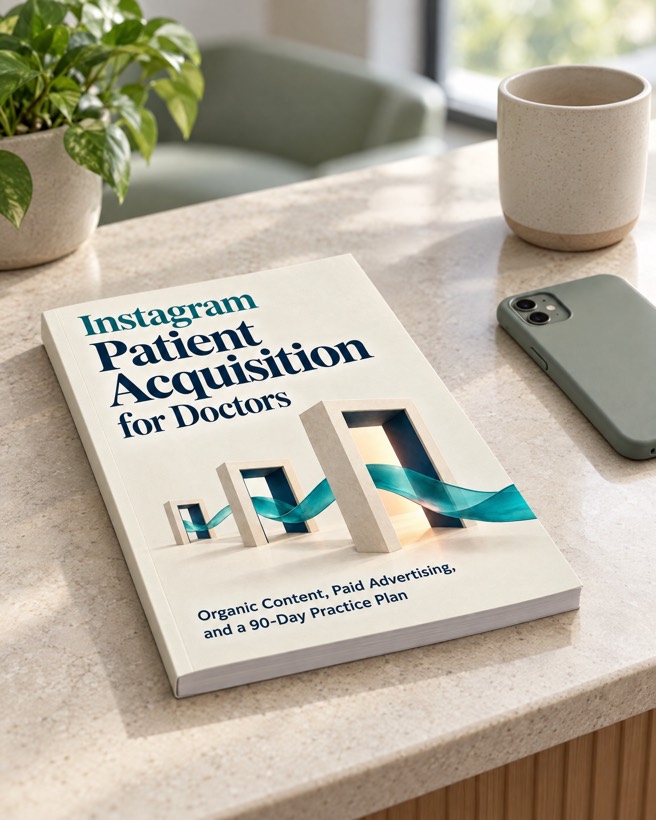
Read three real pages
before you pay.
Not a description of the contents. Three actual pages, reproduced from the manual, at full size.
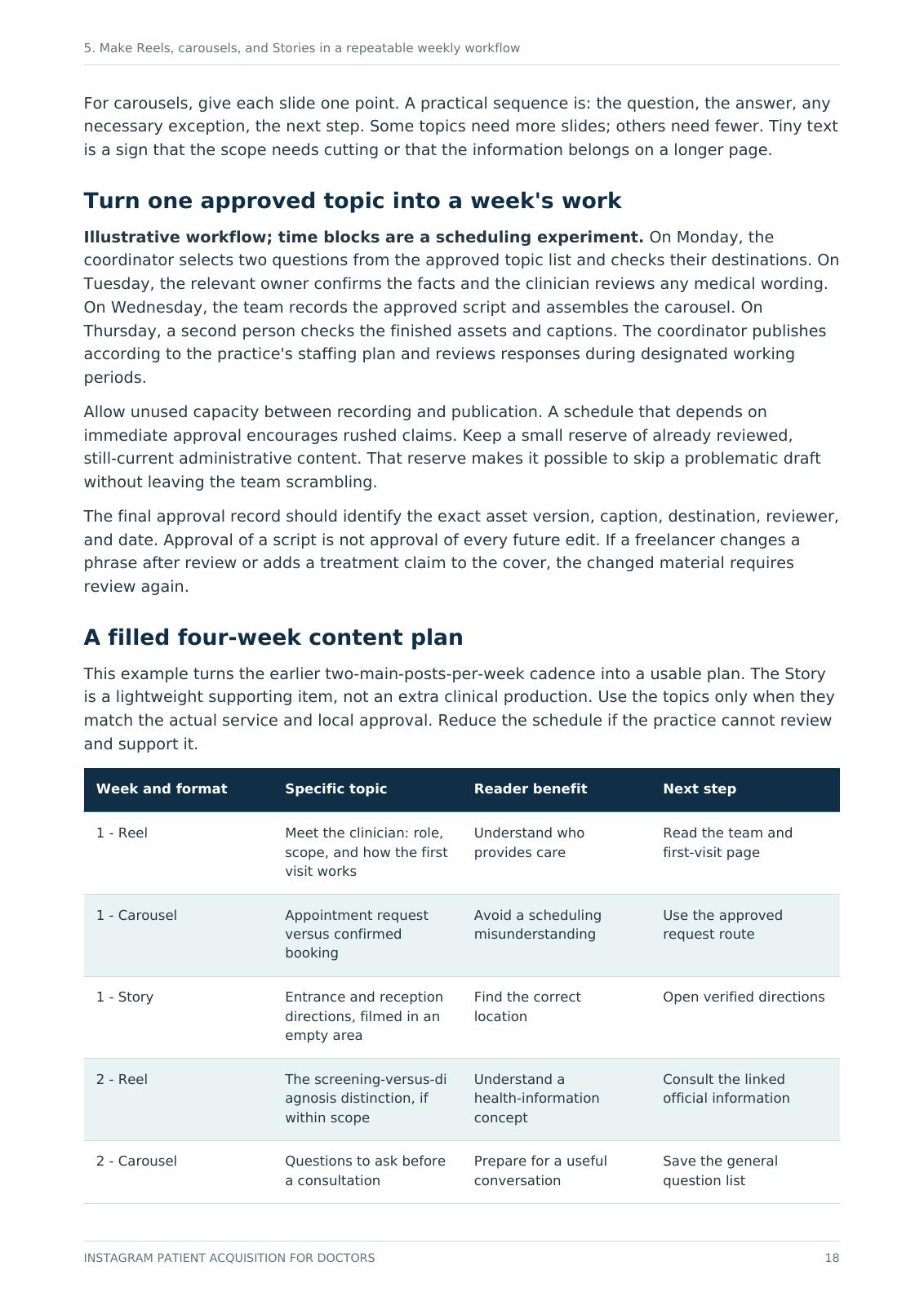
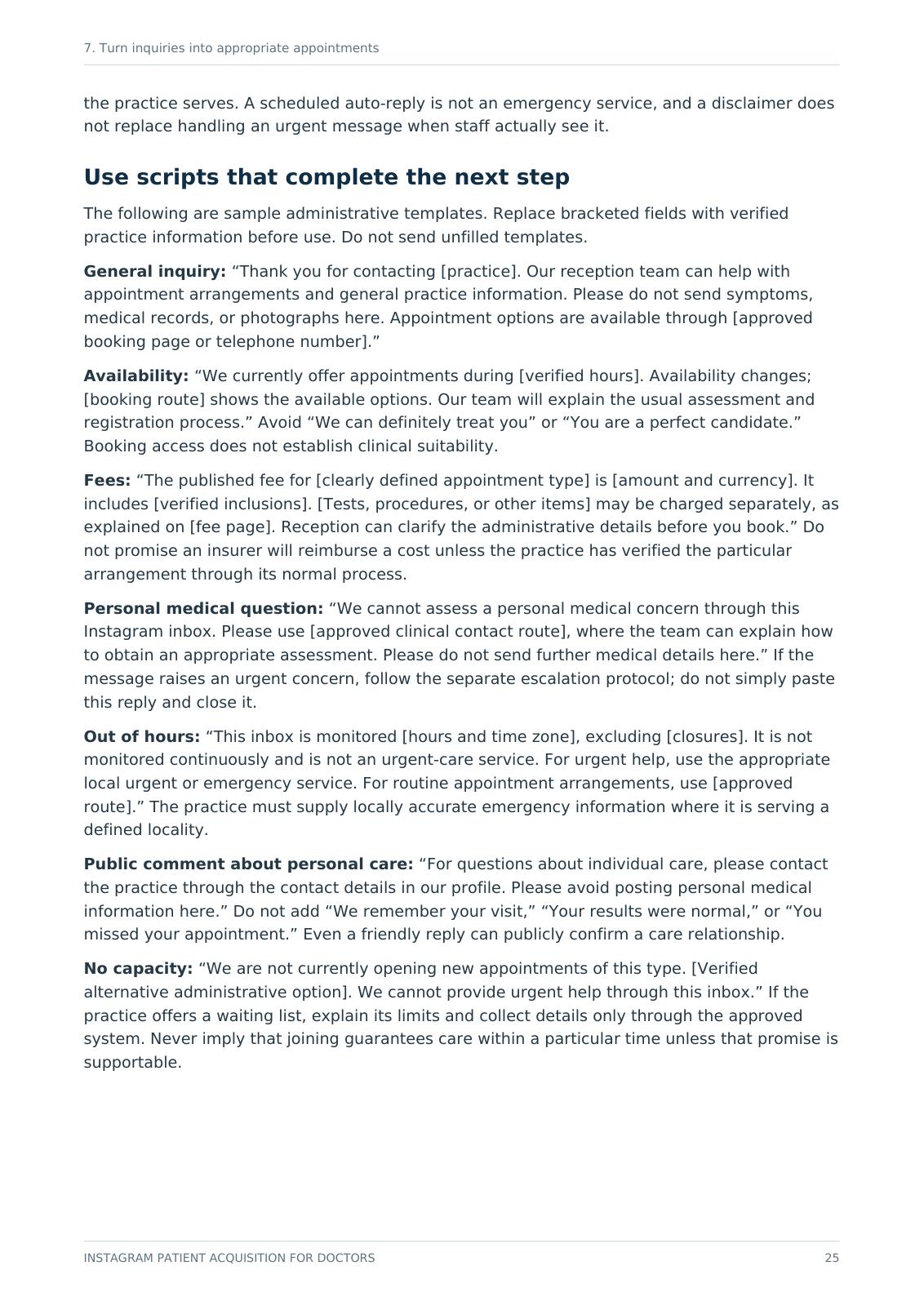
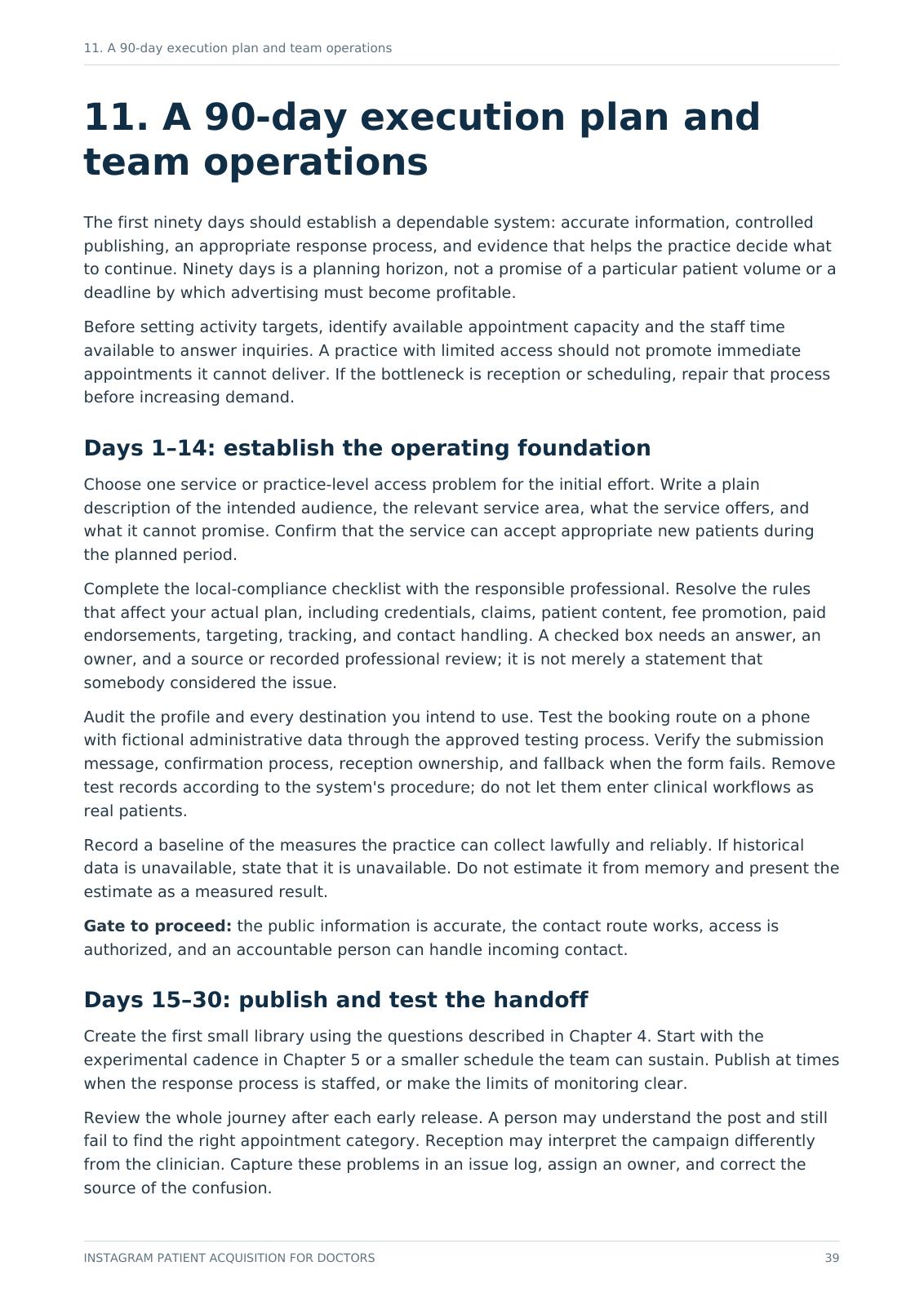
Sample pages reproduced directly from the book. Worked examples are illustrative, not promises of results.
The post worked.
The handoff didn't.
"Are you accepting new patients, and are there appointments after work?" The receptionist replies three days later: "Call us." By then the person has booked somewhere else.Chapter 7, page 24
Nobody owned the inbox. Nobody knew which information to give. The booking route was harder to use than anyone had tested. More reach would not have fixed any of it.
Why this manual exists
Most breaches are accidental.
0of 41
dental practices' Instagram accounts that mentioned or offered skin treatments were compliant, in one published audit. Of the practices' websites, only 7 — 1.8% — fully complied with GDC guidance.
The researchers put it down to "a lack of registrant knowledge surrounding the scope of guidance available" — clinicians breaking rules they didn't know applied. Most Instagram guides aimed at doctors never mention these rules. This one is built around them: a claim register, a local approval record, and a compliance checklist you complete for your own regulator before anything is published.
The manual names all 21 of its sources, with a note on when to re-check each:
- GMC · social media use
- ICO · security and direct marketing
- NHS · screening guidance
- HHS · tracking technologies
- Ahpra · advertising guidelines
- Meta · advertising standards
- Meta · personal attributes
- Meta · health and wellness
- Meta · lead-ad restrictions
- + 12 more
Donnell, Woolley & Worthington, British Dental Journal, 2021 — 450 practices in North East England and North Cumbria, assessed against GDC guidance and ASA-CAP rules. doi:10.1038/s41415-021-2718-4
One tactic from the manual, free
The fix is rarely more posts.
Harbor Medical is the manual's own fictional practice. It posted often and got questions about new-patient appointments. Here is its profile before and after the fix in Chapter 3.
Book now!
harbormedical.example- "Book now" — but the link opens a general homepage
- The phone number there differs from the one on Instagram
- Reception can't tell which slots accept new patients
General practice. City Center. First-visit information and appointment requests below.
First-visit information- Identity and general service
- Location or permitted service area
- One administrative next step
Chapter 1, page 5 and Chapter 3, page 9. 103 characters, three pieces, no treatment claims. The manual is explicit that this is a workflow, "not a case study or a claim that a particular growth rate will follow."
The bible of Instagram marketing for doctors
$24.99.
Less than one no-show.
About two dollars a chapter, once, for a route your team can run without you in the room.

Instagram Patient Acquisition for Doctors
- A filled four-week content calendar p.18
- Reply scripts for seven kinds of inquiry p.25
- A controlled first paid campaign, step by step p.28
- A data dictionary, so reception and marketing count the same thing p.32
- The 90-day plan, week by week p.39
- Seven operating tools, ready to fill in p.42
$24.99 USD · one-time
Get the complete manualSecure checkout with Creem · instant download · no subscription
Questions: support@dentalmoneymodel.com
Refund policy · Terms of sale
Instagram isn't a marketing channel. Done properly it's the front door to your practice.
- 01A useful post or advertisement
- 02The professional profile
- 03Practice information or booking page
- 04An administrative inquiry
- 05An appropriate appointment
- 06An attended first visit
Chapter 1, page 4. Six decisions happen along that line: is this practice relevant to me, is it credible, can I understand the next step, can I contact it safely, does the appointment fit, and was the service what was promised.
Try it on your own practice
Find where your route leaks.
Chapter 10 reads the journey backwards to find what is actually broken — capacity, information or distribution. Enter last month's numbers. Nothing you type leaves your phone.
Example figures shown — replace them with yours.
22 of your 40 inquiries never became a booking. That usually means the person did not get a clear, fast answer about fees, location or the next step. It is the handoff the manual opens Chapter 7 with.
Where the manual fixes it: Chapters 3 and 7
A hypothesis to check, not a diagnosis — which is exactly how Chapter 10 treats it.
Get the manual — $24.99Get high-ticket patients from Instagram — by choosing the service line first.
- Pick one service line for the first experiment
- Write a service promise the team can actually keep
- Make the differences concrete, not adjectival
- Decide what the first month is meant to teach you
Chapter 2, pages 6–8. Reach comes after that, not before.
All the marketing secrets
in one manual.
Twelve chapters, in the four groups the book itself uses.
- FoundationChapters 1–3The patient journey before the audience. A credible promise. The profile as a front door.
- OrganicChapters 4–6Content that helps patients choose, in a repeatable weekly workflow. Local discovery.
- DemandChapters 7–9Inquiries into appointments. A controlled paid campaign. Measuring bookings safely.
- DecisionsChapters 10–12Diagnose the constraint. The 90-day plan and team operations. Local compliance and tools.
All twelve chapters, with the page each starts on
01Build a patient journey before building an audience
Map the route from useful content to an appropriate attended appointment. Give every handoff an owner. Starts on page 4.
02Choose a service, a patient need, and a credible promise
Define one focus for your communication, using claims your practice can support and approve. Starts on page 6.
03Turn the profile into a reliable front door
Make your bio, pinned posts, highlights, and contact route easier for prospective patients to navigate. Starts on page 9.
04Content that helps patients choose appropriate care
Build content around useful questions, clear explanations, and the information people need to take the next step. Starts on page 12.
05Make Reels, carousels, and Stories in a repeatable weekly workflow
Use a filled four-week content calendar and a practical approval and production workflow. Starts on page 16.
06Local discovery and professional community
Plan local visibility and professional relationships without relying only on follower counts. Starts on page 21.
07Turn inquiries into appropriate appointments
Use administrative response scripts and a routing matrix for reception, clinical questions, and urgent concerns. Starts on page 24.
08Build a controlled paid Instagram campaign
Create a launch card, set a budget, choose review dates, and define when to stop a test. Starts on page 28.
09Measure bookings while protecting sensitive information
Track inquiries, confirmed bookings, and attendance using clear definitions and aggregate reporting. Starts on page 32.
10Diagnose the constraint and spend against a decision
Use a troubleshooting sequence and experiment cards to choose the next change deliberately. Starts on page 36.
11A 90-day execution plan and team operations
Move through foundation, publishing, controlled comparisons, and a continue/change/stop review. Starts on page 39.
12Local-compliance checklist and ready-to-use operating tools
Bring together approval records, claim registers, response cards, publication tickets, and review processes. Starts on page 42.
Seven tools you can put
on the desk on Monday.
Chapter 12 is a working pack, not a summary. The bracketed fields are meant to be filled in.
- The local approval record
- A claim register
- An administrative response card
- The publication ticket
- The monthly practice review
- A response to accidental disclosure
- A quarterly decision to continue, change, or stop
A starting point. A rhythm. A review.
Build the foundation.
Choose a service, review claims, clarify the profile, and assign responsibility for inquiries.
Publish & connect.
Put the content workflow and reception handoff into practice. Check how the route works.
Compare with care.
Run controlled comparisons, review the booking journey, and keep decisions tied to evidence.
Decide what's next.
Review the results. Continue, change, or stop activities based on your practice's capacity and findings.
Ninety days is a planning horizon, not a promise of patient volume or a deadline by which advertising must become profitable.
Written for the practice. Useful across the team.
Use it if…
- You own or run a practice and decide how it is promoted
- You have an account that isn't producing booked appointments
- You want the reception handoff fixed before you spend more on reach
- You need every published claim to survive a regulator
Skip it if…
- You want a guaranteed number of patients. It refuses to promise one.
- You want posts to copy and paste. It is a method, not a template pack.
- Your diary is already full. Chapter 10 would tell you to fix capacity first.
- You need clinical or legal advice for your jurisdiction. It is neither.
Know what you're buying.
A 46-page operational manual. It describes a planning, publishing and measurement process. It does not promise, predict or guarantee any number of inquiries, bookings, patients or revenue. Examples are illustrative constructions, not records of customer results. Outcomes depend on your service, market, capacity, team and execution.
It is not clinical guidance and not a jurisdiction-specific legal opinion.
Platform and policy sources checked 26 September 2026. Each one is named in the manual, so you can re-check it yourself.
Before you turn the page.
Do I need to be running Instagram ads already?
No. The book begins with the patient journey and the profile, and treats paid campaigns as chapter 8 — something you add once the route in front of it actually works.
Is this only for dentists?
No. It is written for doctors, dentists and private-practice owners generally. The worked examples are country-neutral, and UK, US and Australian rules are used to show where requirements differ.
Is there an upsell or a subscription?
No. You pay $24.99 once and download the PDF. Nothing is offered to you after checkout, and nothing renews.
What exactly do I receive?
A 46-page PDF, downloadable immediately after payment. No printed copy, no subscription, no login.
Does it guarantee patients within 90 days?
No. Ninety days is a planning horizon, not a promise. The manual is explicit that its examples are illustrative and not records of results.
Can I preview it, and are refunds offered?
You can read three actual pages and every chapter description on this page before deciding. Our policy is all sales final, except where applicable consumer law requires otherwise. See the full refund policy.
Will it work in my country?
The method is country-neutral and chapter 12 is a local-compliance checklist you complete for your own regulator and service before publishing anything.
Who on my team should read it?
Chapters 1–3 and 10–12 are for whoever decides. Chapters 4–6 are for whoever makes content. Chapter 7 is for whoever answers the inbox.
How current is it?
Platform and policy sources were checked on 26 September 2026, and the manual names each one so you can re-check it yourself.
Your practice doesn't need another random post. Give it a connected plan.
P.S. If you remember one thing: a diagnostic for where your route leaks, seven operating tools and a 90-day plan, written against the rules your regulator actually enforces. $24.99, once. Read three real pages above before you decide.